
‘Brands seek to leverage their equity across multiple geographical regions, representing myriad cultures, while advertising agencies ramp up their knowledges of global trends.’
Altstiel and grow, 2017, p. 112
We all know that an advertising is aimed at conveying the values of a brand, for global brands such as Nike and McDonald’s, their branding is hyperconsistent, with mostly similar messaging regardless of cultural differences. However, understanding differences between cultures is still important to spread their values in different countries.
Professor Geert Hofstede, Gert Jan Hofstede, Michael Minkov and their research teams have came up with six dimensions of national cultures in order to study how values in the workplace are influenced by culture. The Hofstede model consists of six dimensions, Power Distance Index (PDI), Individualism versus Collectivism (IDV), Masculinity versus Femininity (MAS), Uncertainty Avoidance Index (UAI), Long Term Orientation (LTO) and Indulgence versus Restraint (IVR).
In the next paragraphs, I will apply this model in comparison between two advertisings of Nike from the United States and China.
Nike – Just Do It (2017)
by Weiden + Kennedy Shanghai
This is one of the series of campaign done by Weiden +Kennedy Shanghai in 2017 to represent Nike’s slogan – Just do it. It features four young athletes keep fighting after the downs.
Nike – Better (2020)
by Weiden + Kennedy Portland
This is a video created by Weiden + Kennedy Portland in memory of famous NBA player Kobe Byrant. Kobe taught us to be better. ‘We keep up every single day to get better today than you were yesterday and ever it takes.’
When typing in China and the United States in the Country Comparison Tool on Hofstede Insights, the result will come like this:
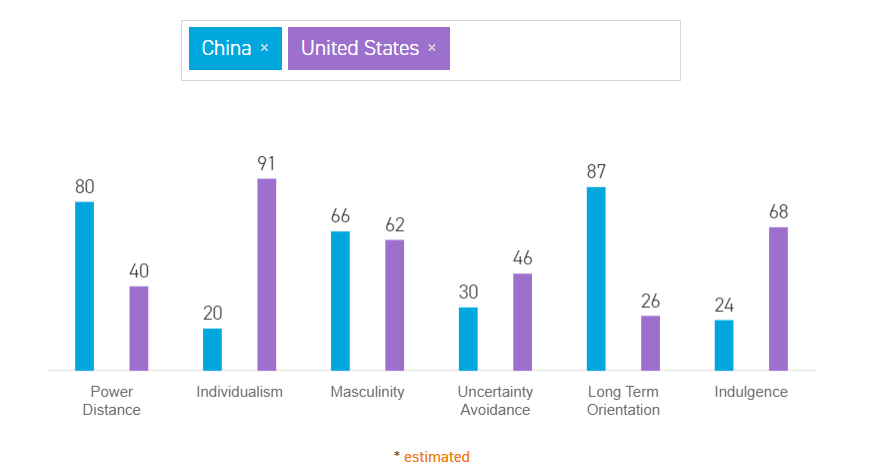
In the bar chart, the top three dimensions with largest difference is Individualism, long term orientation and indulgence.
Individualism
Individualism has to do with whether people´s self-image is defined in terms of “I” or “We”. The interesting thing is that, both ads are telling stories in personal perspectives.
As one of the most individualist (91) country in the world, there is explicit emphasis on equal rights in all aspects of American society and government. This is also reflected in the ad video as the voice over says ‘better generation, better nation’.
Long Term Orientation
This dimension describes how every society has to maintain some links with its own past while dealing with the challenges of the present and future (Hofstede Insights N.D.)
In China, one of traditional virtues is ‘never give up’, and it is delivered in the ad. The ad also shows how Chinese young athletes apply this tradition to changed conditions.
On the other hand, as a much younger country, America tends to absorb opinions from anyone, and do not have much rules.
Indulgence
This dimension is about the extent to people ‘restrain’ themselves by controlling desires and impulses. In China, children are raised in the environment that actions are restrained by social norms.
In America, the environment is ‘Work hard, play hard’, you can be better walker, better winner, but you can also be better eater and better dreamer.
We cannot judge which culture is better, as each culture has its own shining point. For advertising agencies, mix local cultures and the brand value will be effective in aiming global markets.
Reference:
Altstiel, T & Grow, J 2017, Advertising Creative: Strategy, Copy, and Design, Sage, Thousand Oaks, California.
Hofstede Insights n.d., ‘National Culture’, Hofstede Insights, retrieved 20 June 2018, <https://www.hofstede-insights.com/models/national-culture/>.
 Seasalt Milkshake
well done! Met my expectations!
赞赞