
Online identity is a large subject which has close relation to influence of social media. Social media websites work as a public sphere, where people can ‘come together as a public’, and express and exchange ideas freely. Smith and Watson (2014) wrote a toolkit in order to explain subjectivity and identities online.
One’s online live is usually linked to others, family, friends, or affiliations. Different from the reality, the attachments between online lives are mostly media personages, consumer products and similar preferences of art or music from online resources such as YouTube (Smith and Watson, 2014).
The appearance of online identity is closely related to the online community. The World Wide Web is transformed into a social experience, offering new and free possibilities for self-construction (Frunzaru and Garbasevchi, 2016).
In this blog post, I will discuss about some aspects of online identity, and relate to my own experience.
What is self-presentation?
The word ‘self’ is used as ‘shorthanded term for acts of self-reference’. On social media websites, users often reveal the ‘real’ essence, create an image of ‘me’ which is unique, singular and outside social (or other) constraints.
The online identity is constructed and situated in online society, which is not identical to its flesh-and blood maker (Smith and Watson, 2014).
Online self-presentation is temporal and ever-changing. Overtime, the online self-presentation will create an archive of the body on social media platforms such as Facebook or YouTube.
How important the online identity is?
‘Every piece of information available online about an individual carries relevant identity clues’ (Frunzaru and Garbasevchi, 2016). The entire life narrative and the individual’s imagined identity can be reconstructed using various types of data online, and on some occasions, online identities can be equivalent to commodity or business assets.
Online identity in experimental communities
Apart from social media platforms, Massive Multiplayer Online Role Playing Games (MMORPGs) is also an example of experimental communities where worldwide people creating characters, performing roles, developing virtual possessions, and interacting through virtual worlds (Pinto et al, 2015).
In traditional online communities, the identity shown by individuals may be restricted to certain type, such as the professional self, while in experimental communities like Final Fantasy XIV (FF14) people can activate multiple identities.
Experimental communities offers people with enormous possibilities to construct and rebuild their online presentations through consumption and active anticipation in game. Gamers can create multiple characters and extend the sense of self through avatars and virtual possessions.
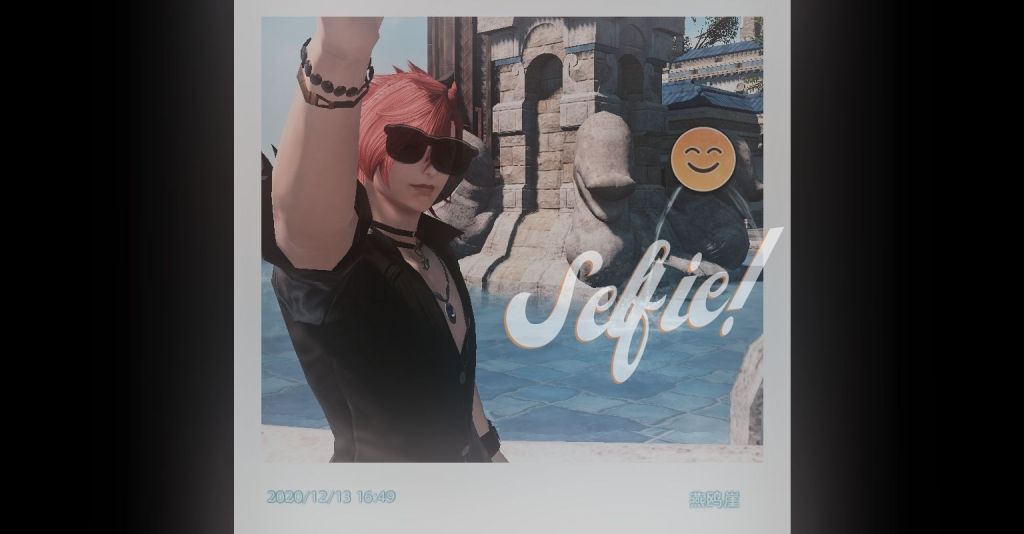

My avatar in game is combination of my actual characteristics and characteristics of my ideal self. For me, the constructed avatar in online community has become the way to deal with tensions from offline life. My online persona is basically an ideal ‘me’ with completely different appearance, experiencing adventures, participating in communities. Without physical presence, experimental communities offer a public sphere with much higher freedom than reality.
The formation of one’s identity is directly related to interactions with other people (Pinto et al, 2015). The notion of ‘I’ cannot exist without the conception of ‘we’. In FF14, gamers organize themselves in free companies or teams which allow them to reach achievement that can only be done through teamwork, and some of the top teams in Japan and Europe district also use social media websites to share their game life.
The ‘free company’ in FF14 is a guild-like community organized and operated by gamers to communicate, share resources and information, and help each other to go further in the game. A free company can have a house in game for activities. In 2018, me and some of my friends met in FF14 organized a small free company. In two years, the number of members increased from 5 to over 50, and some of us met in offline activities and become friends in real life.
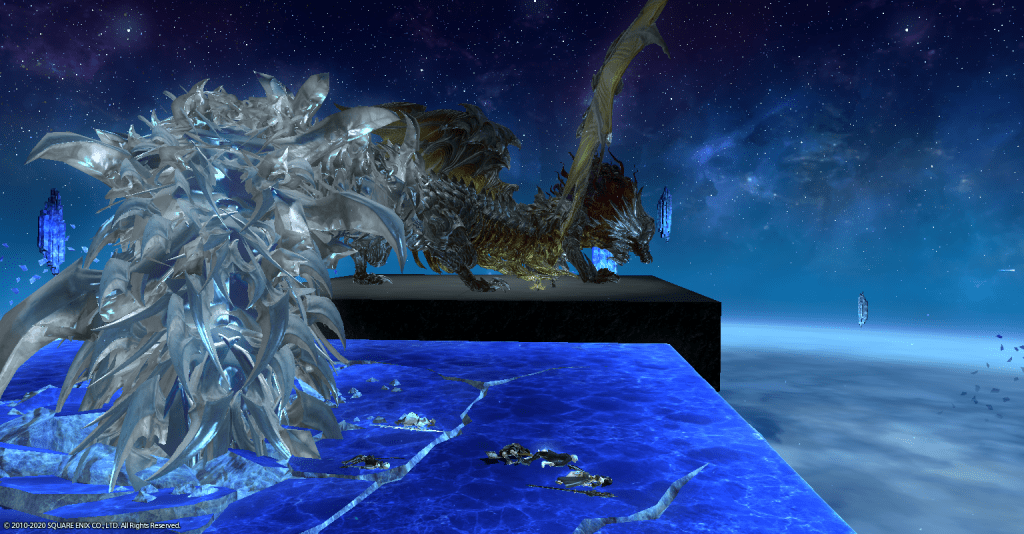
Other than game contents that need teamwork, FF14 also provides a lot of interesting contents for individuals, such as fishing, gathering and crafting, photography (gpose) and house decoration. I have created a Twitter account mainly about FF14 three years ago to record my game life and housing designs in screenshots.
After having a cat in October 2020, I was able to reconstruct my online identity by involving photographs of my cat on social media platforms.
Reference:
Smith, S and Watson, J 2014, ‘Virtually Me: A Toolbox about Online SelfPresentation’, in Poletti, A and Rak, J (eds.), Identity Technologies: Constructing the
Self Online, The University of Wisconsin Press, Madison, pp. 70-95.
Frunzaru V and Garbasevchi D (2016), ‘Students’ Online Identity Management’, Journal of Media Research, 9(24): 3-13
Pinto DC, Reale G, Segabinazzi R and Rossi CAV (2015), ‘Online identity construction: How gamers redefine their identity in experiential communities’, Journal of Consumer Behaviour, 14: 399-409, doi: 10.1002/cb
 Seasalt Milkshake