
Storyboard
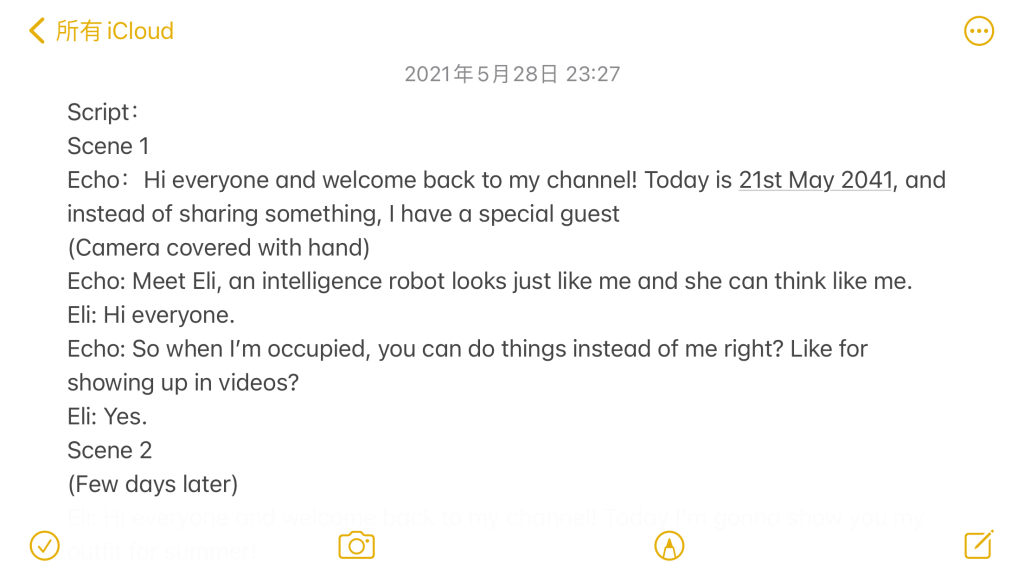
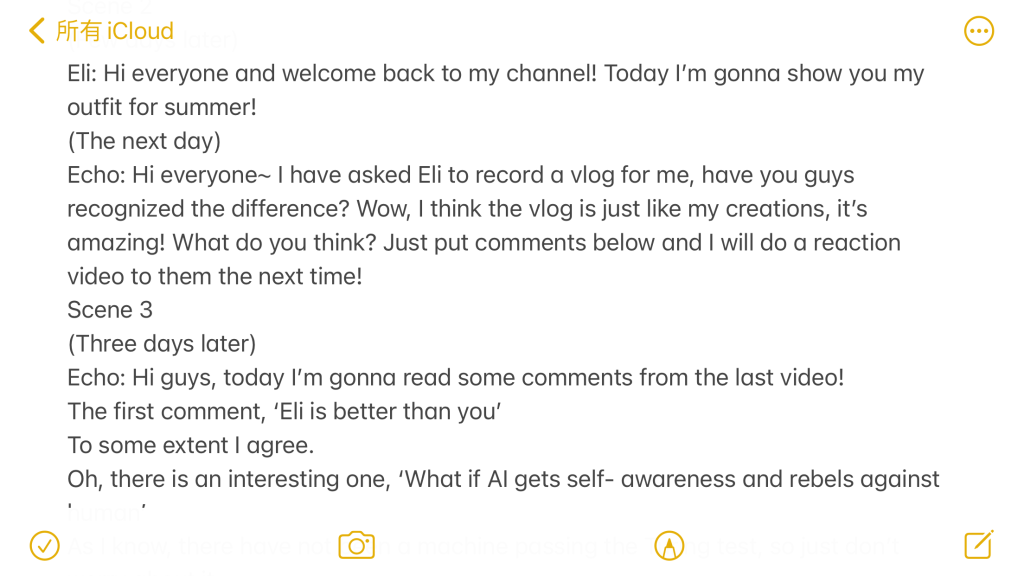
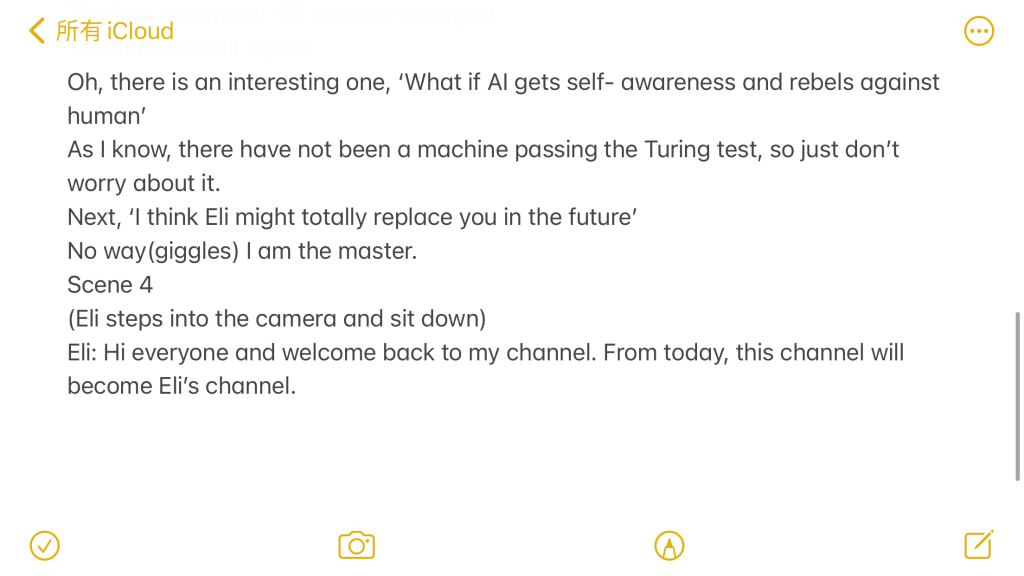
In future (2041) A vlogger (Echo) gets the chance to get a robot (Eli) which has the exactly same appearance as her, and the robot has artificial intelligence.
She was happy in the beginning, as she found that having an AI self is cool, and she can ask Eli to livestream when she is occupied.
But what she does not know is, Eli has the attempt to replace her. As Echo asked Eli to take her place when live-streaming more and more, Eli has found out the way to eliminate her.
One day when Echo wakes up, she finds that someone has locked her in a small room, while Eli sits on her chair and starts live-streaming.
Reflection
This is my beginning of the informational video. The video is an analytical video talking about common questions and advantages and disadvantages of AI, explained by some real world examples. I chose to start with a short and a little bit creepy scene play is because I want to make a ‘hook’ to attract audience’s attention and make them want to know what will happen next.
Also, it is a common issue that people think AI will destroy people in the future, especially in many sci-fi movies and video games, so I decide to include that part in my video. I played the two roles, Echo and Eli, so for distinguishing I dressed different clothes except for the final scene, where Eli became Echo.
After communicating with Bob in the class, I decided that my second informational video will talk about advantages and disadvantages of AI. For each side, we have worked out 4 points. Then I found that for a 7-minute video, these contents are far away from enough. So, I watched some videos of the same kind on YouTube and add the Q & A to my video. The idea of the short scenario came out my mind suddenly, and the original script had more plots than the video showed, but time was not enough to put all those in, and I decided to delete some parts.
Since I decided to play two roles by myself, the challenge is how to put two of me in the same frame. I came out with the solution that shoot two videos in the same camera stand, and in the first video I sit on the right, then change to left in the next. Then, when editing I assembled the two videos by aligning then horizontally. I recorded the video and audio using the same device, so the voice level was low, and I increase it when editing. After making two videos, I found that it is not difficult to talk to the camera anymore, therefore I tried to add more things like face expressions, gestures and changes in intonation in my video.
When searching for resources, I mostly relied on Deakin University Library and educational videos on YouTube. As I do not want to make a video that is difficult to understand, I choose resources that are closer to applications of AI rather than the professional conference reports and papers.
The music used in the video is a creative commons music by Chris Zabriske. To avoid music conflicting with my voice, I decide to choose a light and soft music. I searched for music with creative commons license on bandcamp and finally stopped at the album made by Chris Zabriske.
I was trying to shoot with my digital camera at start, but I found my tripod was too high to put on the table, and I cannot see my face clearly through the screen of my little camera, so I decided to shoot with my phone as before. I used the front-facing camera to shoot this time, as I want to know how I look in the camera to adjust my face expressions and other things, also it saves me a lot of time to find where the camera is and keep redoing the shooting.
It’s hard to bring all of my scripts into the video due to limitations in devices and place, so I decided to present them as a series of vlogs. To my extent, this trick works well as vlog is closer to life, and can easily bring people into the scenario I worked out before they know.
Reference
Shane J (13 November 2020) ‘The danger of AI is weirder than you think’ , TED, YouTube, accessed 21st 2021.
Harris S (20 October 2016), ‘Can we build AI without losing control over it?’ , TED, YouTube, accessed 21st 2021
Reddy, S (ed.) 2020, Artificial Intelligence : Applications in Healthcare Delivery, Productivity Press, Milton. Retrieved from https://ebookcentral-proquest-com.ezproxy-b.deakin.edu.au/lib/deakin/reader.action?docID=6372282
Sarangi S and Sharma P (2018) Artificial Intelligence : Evolution, Ethics and Public Policy, Taylor & Francis Group, Milton. Retrieved from https://ebookcentral-proquest-com.ezproxy-f.deakin.edu.au/lib/deakin/reader.action?docID=5517469
Jennings C (2019) Artificial Intelligence : Rise of the Lightspeed Learners, Rowman & Littlefield Publishers. Retrieved from https://ebookcentral.proquest.com/lib/deakin/detail.action?docID=5760378.
Keep Up the Momentum, Friend by Chris Zabriskie 2020 (CC-BY-3.0)
 Seasalt Milkshake