
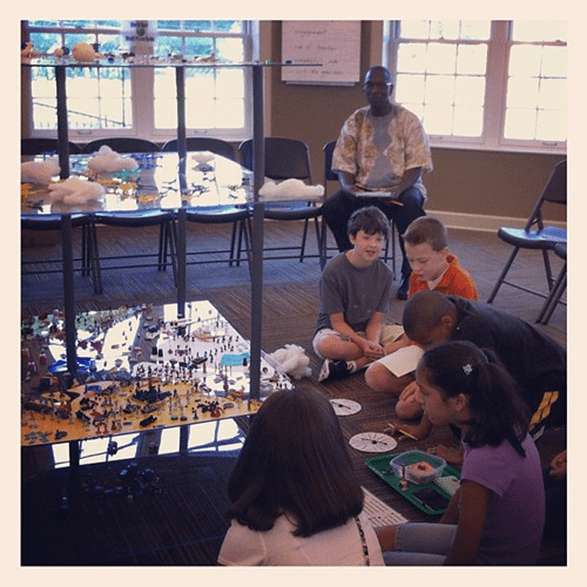
Let’s imagine a situation when 4th-graders are involved in international crises—these include ethic and minority tensions, nuclear proliferation, environmental disasters, famine, endangered species and global warming. Do you believe that 4th-graders can solve these problems? Actually, these 4th-graders have solved global warming in one week, and they also have solved other crises for several times.
This success was created by John Hunter with his World Peace game. It started out from a 4’x5’ plywood board with all the problems of the world put on in 1978, when John Hunter was creating a lesson for African students. He spoke in the ted talk, “I didn’t want to lecture or have just book reading. I wanted them to be immersed and learn the feeling of learning through their bodies.” He knew schoolkids like game, so he has created something interactive. Through years of evolving, the World Peace Game becomes a 4’x4’x4’ plexiglass structure.
This brings us to today’s topic: gamification and education. In other words, I will talk about application of game characteristics in this blog post.
In “Where in the World Is Carmen Sandiego” , an educational detective-simulation video game, player will travel all across the globe in search for the legendary female Fatale Carmen Sandiego, track down her whereabouts and capture the criminal in this classic game, put criminals behind bars to catch up the legendary criminal in the end.
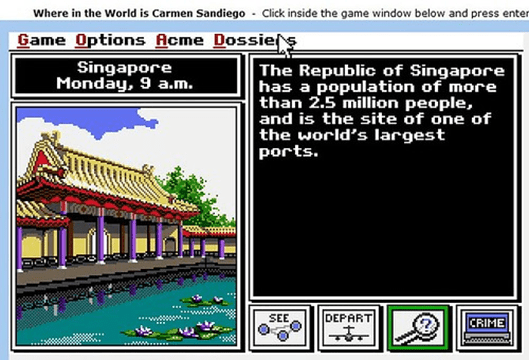
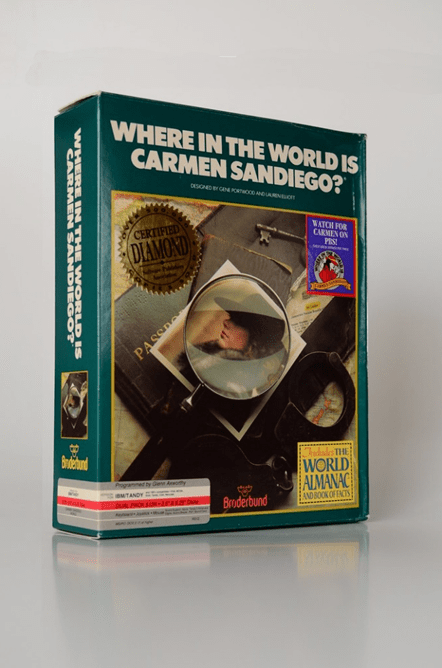
This 1985’s game is an early example of gamification. Games attract attention from educators as the ability to engage players and sustain their interest. Problems of low student interest and engagement in the class are not new to educators (Kim et al, 2018, p.40). In the book Gamification in Learning and Education: Enjoy Learning Like Gaming, Kim et al define gamification in education and learning as follow: “A set of activities and processes” “To solve problems related to learning and education” and “By using or applying the game mechanics” (Kim et al, 2018, p.40).
Characteristics of gamification
- Gamification is a series of relevant activities and systematic processes
- Gamification should be problem-based (have a purpose to solve specific problems)
- Gamification is not based on mere usage of game mechanics such as badges and points. Gamification should be based on the characteristics of game elements.
When it comes to the type of game used for gamification in education and learning, Kim et al recommend serious game. Serious game is the game developed in a purpose other than entertainment. Zyda describes the purpose of serious game as “uses entertainment to further government or corporate training, education, health, public policy, and strategic communication objectives” (p.26).
For education, serious game which is implemented with real-world environments should be applied (Kim et al, 2018, p.41). Gabe Zichermann, an entrepreneur and author whose work centers on gamification, says that games actually make kids smarter.
He quotes Andrea Kuszewki’s opinions of five things that people can do to increase their grey matter:
• Seek novelty
• Challenge yourself
• Think Creatively
• Do things the hard way
• Network
And these 5 things resemble basic patterns of video games:
• A continuous process of learning
• Game presents challenge, and the process of overcoming the challenges triggers the dopamine loop inside brain, which brings people back to keep seeking that activity over and over again
• Multitasking, multiplayer, quick-paced
Gamification intrinsically motivates students, as it helps them to “feel pleasured, be friendly and imaginative, and self-actualized” (Najjar and Salhab, 2021, p.2). It also extrinsically motivates students through acquiring rewards, points, ladderboards and avoiding punishments. Both intrinsic and extrinsic motivations are important in promoting students’ learning engagement (Najjar and Salhab, 2021, p.2).
Through research, Najjar and Salhab affirm that gamification can bring positive behavioral outcomes, and encourage educational institutions to apply gamification early to make students get used to gamification through interacting with the virtual world (Najjar and Salhab, 2021, p.4).
References:
Hunter J (March 2011) ‘Teaching with the World Peace Game’ , TED-ed, accessed 28 April 2022.
Kim S, Song K, Lockee B and Burton J (2018) Gamification in Learning and Education: Enjoy Learning Like Gaming, Springer International Publishing AG
Najjar E and Salhab R (2021) ‘Position Paper: Gamification in the Learning Process’, iJOE, 18(1):148-153, https://doi.org/10.3991/ijoe.v18i01.26609
Zichermann G (June 2011) ‘How games make kids smarter’ , TED-ed, accessed 28 April 2022.
Zyda M (2005) ‘From visual simulation to virtual reality to games’ Computer, 38(9):25–32. doi:10.1109/MC.2005.297
 Seasalt Milkshake